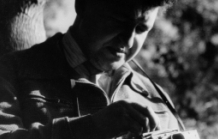
The Municipal Museum Amadeo de Souza-Cardoso (MMASC) shows, from September 16, the exhibition "In the eyes of Eduardo". Organized by the Vicente Risco Foundation and the Association for the Creation of the Eduardo Teixeira Pinto Museum, the exhibition consists of 80 photographs and can be seen until October 29.
Often awarded during his lifetime, Eduardo Teixeira Pinto was, in the words of José Luis Gaspar, Mayor of Amarante, "a master in the art of photographing the daily life of a people, marking several generations on the Earth where he lived and where, by the way, never wanted to leave. He was, above all, a lover of Amarante who peered into the most intimate nook, leaving an undisputed and incalculable documentary legacy. "
"Amadeo de Souza-Cardoso lives in the beauty of his paintings, Teixeira de Pascoaes in the eloquence of his words, but also Eduardo Teixeira Pinto will live forever in the magnificent and splendid images that he bequeathed to us", writes José Luis Gaspar.
Eduardo Teixeira Pinto was born in the parish of S. Gonçalo, Amarante, in 1933. He began to take his first professional photographs in 1950, becoming an exhibitor since 1953 in several photography halls on five continents.
He was an active member of several communities of photographers, namely the Photographic Association of Porto, the Camera Group (Coimbra) and the Photographic Association of the South (Évora).
He inherited from his father, also photographer, the pleasure of photographing. His long life experience and his poetic look at reality have made him one of the best and most awarded Portuguese photographers of the 20th century.
His work deals with several themes, highlighting Nature and the human figure, which he has so well reconciled.With photographs such as «Rodopio», «Church of S. Gonçalo», «De Regresso», «Theme of Painters», «Matinal» and «Quietude», among others, won numerous prizes in Portugal and abroad, namely the Grand Prix of Camões (1960), one of the highest national distinctions.
Deceased in 2009, Eduardo Teixeira Pinto was averse to honors and distinctions. It left behind a photographic collection of incalculable value, which also includes a vast collection of cameras, some of which are worthy of museological cataloging.
Often awarded during his lifetime, Eduardo Teixeira Pinto was, in the words of José Luis Gaspar, Mayor of Amarante, "a master in the art of photographing the daily life of a people, marking several generations on the Earth where he lived and where, by the way, never wanted to leave. He was, above all, a lover of Amarante who peered into the most intimate nook, leaving an undisputed and incalculable documentary legacy. "
"Amadeo de Souza-Cardoso lives in the beauty of his paintings, Teixeira de Pascoaes in the eloquence of his words, but also Eduardo Teixeira Pinto will live forever in the magnificent and splendid images that he bequeathed to us", writes José Luis Gaspar.
Eduardo Teixeira Pinto was born in the parish of S. Gonçalo, Amarante, in 1933. He began to take his first professional photographs in 1950, becoming an exhibitor since 1953 in several photography halls on five continents.
He was an active member of several communities of photographers, namely the Photographic Association of Porto, the Camera Group (Coimbra) and the Photographic Association of the South (Évora).
He inherited from his father, also photographer, the pleasure of photographing. His long life experience and his poetic look at reality have made him one of the best and most awarded Portuguese photographers of the 20th century.
His work deals with several themes, highlighting Nature and the human figure, which he has so well reconciled.With photographs such as «Rodopio», «Church of S. Gonçalo», «De Regresso», «Theme of Painters», «Matinal» and «Quietude», among others, won numerous prizes in Portugal and abroad, namely the Grand Prix of Camões (1960), one of the highest national distinctions.
Deceased in 2009, Eduardo Teixeira Pinto was averse to honors and distinctions. It left behind a photographic collection of incalculable value, which also includes a vast collection of cameras, some of which are worthy of museological cataloging.